

Finding Harmony: Voices, Stories, and Live A Cappella Music

Written by Lisa Church
When Pauline Quinn, a Roxbury resident and volunteer with Roxbury Arts Alliance, first introduced us to Somerset Hills Harmony, it came from personal experience. Pauline has been singing with the group for about two years after returning to Roxbury with her family and searching for a musical outlet during a very difficult life chapter.
“I have a love of singing. I grew up with a lot of music around me, but I have no formal voice training. If you told me then what I would be doing with the group now, I would have been too nervous to join.”
Recognizing the emotional and physical benefits she had experienced singing with her church choir in New York, Pauline began looking for options closer to home and discovered Somerset Hills Harmony online. She noted how particularly healing it felt to move her voice and body in the way required by a cappella singing. “I love going to practice. It’s a lot of fun, and our members are really talented.”
Who Is Somerset Hills Harmony?
Somerset Hills Harmony, ironically shortened to SHH, is a 40-person mixed a cappella chorus based in central and northern New Jersey and the Somerset Hills Chapter of the Barbershop Harmony Society. While its current mixed-ensemble format is a more recent evolution, the organization’s roots span more than 75 years.
Somerset Hills Harmony performs a wide-ranging repertoire that includes contemporary, rock, pop, folk, country, Broadway, and classical choral music. The organization includes two ensembles: the full chorus and The Gold Dynamic, a smaller group focused on contemporary a cappella. What unites them is a shared commitment to musical excellence, growth, and a warm, welcoming sense of harmony- both onstage and off.
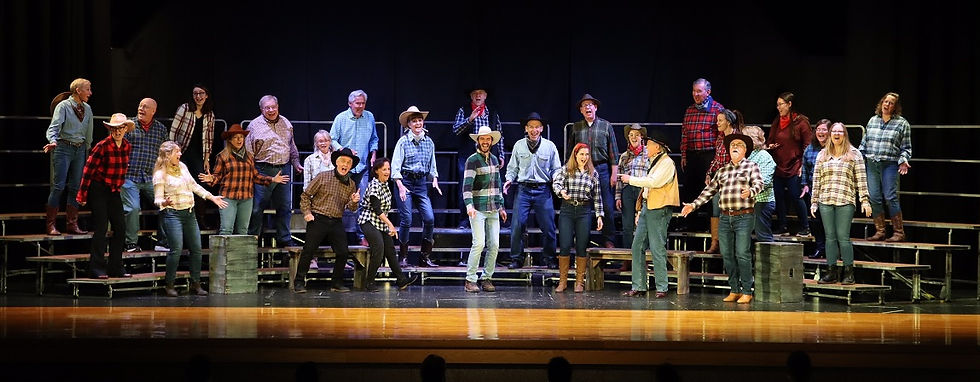
Photo provided by Somerset Hills Harmony - Nazareth, PA, April 2024 - They sang "Burnin' the Roadhouse Down" and "Desperado"
Leadership, Legacy, and a Little Humor
We spoke with Don Staffin, Artistic Director of Somerset Hills Harmony, who described the group as “not your grandfather’s barbershop chorus.”
“I’m an accidental singer.” Don recalled how he got started in vocal music and it was not how you might expect. “In high school, the new choir teacher approached a group of male athletes with an offer we couldn’t refuse. ‘Join my choir and you’ll all get dates to the prom.’ We eagerly joined the predominantly female group, and it was history from there.”
That “accidental” beginning grew into a lifelong passion for contemporary a cappella. Since then, Don Staffin has sung, directed, arranged, and led a cappella ensembles at the collegiate, community, and scholastic levels, playing a pivotal role in shaping Somerset Hills Harmony into the vibrant mixed chorus it is today. His leadership, creativity, and commitment to musical excellence continue to influence singers across generations.
Don and his wife, current SHH President Chris Staffin, both sing in multiple groups and compete internationally. Somerset Hills Harmony has placed 7th in The Barbershop Harmony Society’s Mid-Atlantic Regional Chorus Competition for two consecutive years. This is no small feat considering the talented competition. The Gold Dynamic has also earned recognition for its contemporary repertoire and performance excellence.
Nick Seifert has been Somerset Hills Harmony’s musical director since 2021. He is a music educator and a former member of the chorus’s educational outreach program that provides scholarships for high school and college students to sing for free.

Photo provided by Somerset Hills Harmony - The Gold Dynamic, pictured here, focuses on high-level contemporary repertoire, musical precision, and performance polish in a smaller ensemble setting.
America’s Musical Story: The Roots of Barbershop Harmony
According to research compiled by the Barbershop Harmony Society, barbershop harmony is deeply rooted in African American musical tradition, making it a powerful and often overlooked chapter in America’s musical story.
Research by jazz archivist Lynn Abbott, published in his landmark 1992 paper, revealed overwhelming evidence that barbershop-style quartetting was widespread in Black communities during the late 1800s and early 1900s. African-American singers harmonized popular songs, spirituals, and folk music recreationally, improvising rich, close harmonies that later became hallmarks of the barbershop sound, including what we now recognize as the barbershop seventh chord.
As the style grew in popularity, it was adopted, recorded, and widely distributed by white quartets, while Black quartets were largely excluded from early recording opportunities, reshaping public perception of the music’s origins. Rediscovering and acknowledging these roots aligns directly with Roxbury Arts Alliance’s 2026 theme, Voices of America – Music, Stories & Spirit, honoring not just the sound itself, but the communities, cultural exchange, and lived stories that shaped one of America’s most distinctive vocal traditions.
Harmony as Wellness: Music That Moves the Body and Mind
Group singing engages the brain, breath, and nervous system all at once, creating a powerful sense of calm and belonging. Don Staffin noted that group a cappella singing offers more than musical enjoyment. “Engaging the voice through harmony and breath creates a true mind-body wellness experience.”
When singers produce well-tuned harmony, the brain releases dopamine, reinforcing pleasure and focus, while oxytocin and endorphins support emotional connection and stress relief. The slow, controlled breathing required for sustained harmony also helps regulate the nervous system, lowering tension and promoting calm. In close-harmony styles like barbershop, singers often physically feel the resonance of locked chords, a sensory experience that amplifies these effects and leaves them feeling energized, connected, and grounded.
This helps explain why communal singing has long served not just as entertainment, but as a powerful tool for emotional well-being and social connection, a concept reinforced by RAA volunteer Pauline Quinn, who felt this firsthand. The audience at Spring Forward will experience this mind-body connection for themselves by learning to sing a barbershop tag (the short, climactic song ending) during the performance.
Spring Forward at Roxbury Arts Alliance
“We’re thrilled to have them in our theater on March 22nd, 2026. We have not featured a choir like this before, and it’s especially meaningful to us that one of our own volunteers is onstage with them,” stated a representative of Roxbury Arts Alliance. Tickets are available online now on our EVENTS page. We recommend purchasing your tickets in advance, as seating can’t be guaranteed at the door.
Somerset Hills Harmony has its eyes on continued growth, with an eventual goal of at least 60 singers. You can read more about the chorus, hear their sound, and learn about singing with them at www.SHHchorus.org.
Can't wait to hear them for yourself? Visit their YouTube channel HERE.


Comments